
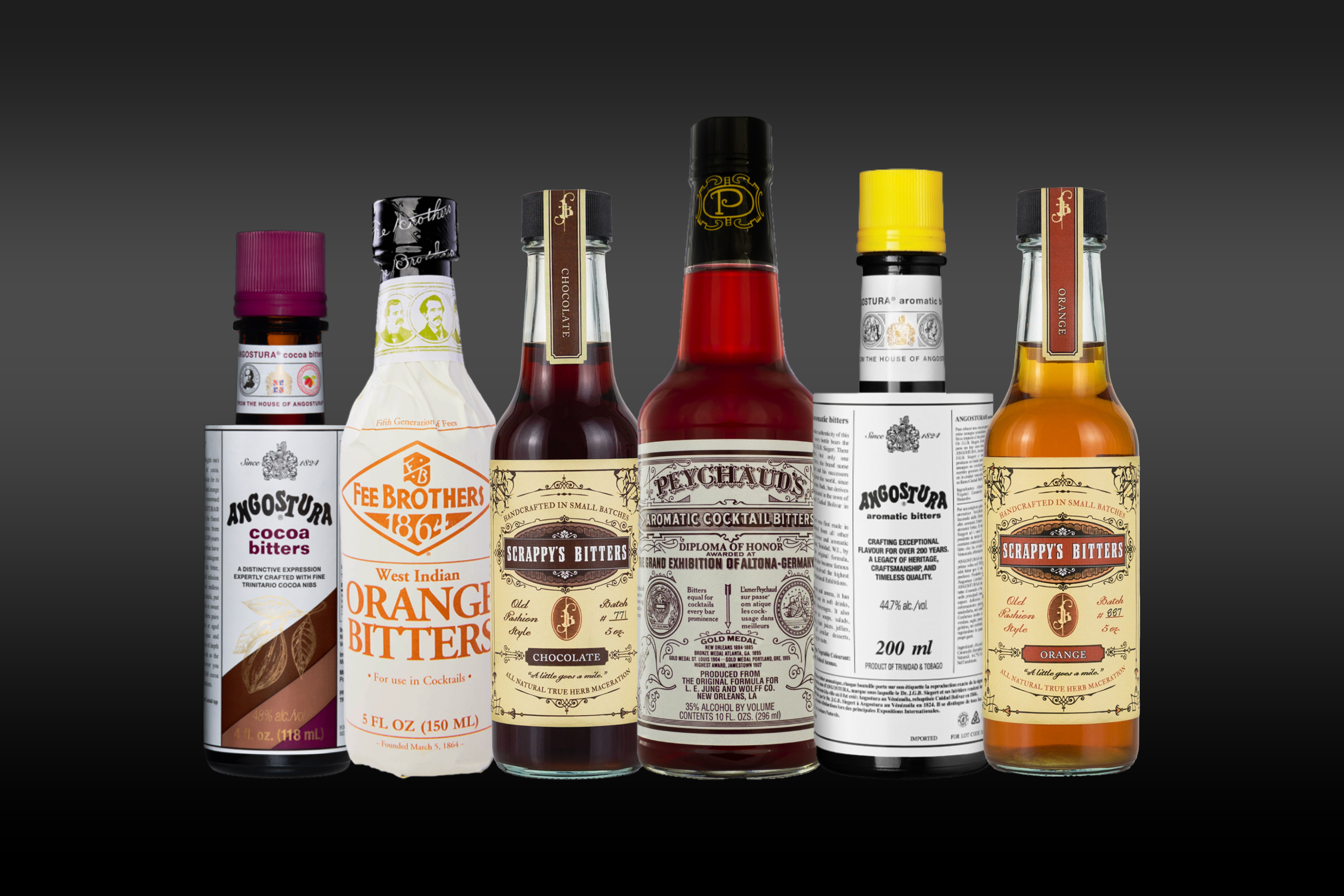
Bitters are concentrated flavouring agents infused with any number of herbs and spices. Think of them as a sort of seasoning for cocktails, used to add, complement and amplify flavours.
Even if you’re not into herb and spice flavours specifically, bitters – when used in small, appropriate quantities – add depth to any drink they’re added to.
As their name suggests, bitters can be pretty… bitter, so they’re a good tool to balance out any sweetness from other ingredients. Most importantly, they really pack a punch, so a little goes a long way; just two or three dashes is usually enough for one drink.
There are loads of varieties out there, but there are four bitters that we think you’ll more or less need:
Angostura
This is the most common and popular brand of bitters. If you come across a recipe that just says “bitters” in its ingredient list, Angostura is a safe bet. Herbaceous and spice-forward, it adds a pop of clove, cinnamon, cardamom, plus a top-secret number of other aromatics.

Angostura is standard for the Old Fashioned and Manhattan, among many other classic cocktails. Be warned, though; we find it quite a bit more aggressive than other bitters, so use it thoughtfully.
Peychaud’s
Peychaud’s noticeably sweeter, less bitter and more anise-forward than Angostura. It’s also a bright reddish orange, though used in mere drops it should barely have an effect on the hue of your final mix.

The fresher profile of Peychaud’s makes it a defining flavour component in drinks such as the Sazerac and Vieux Carre. Don’t be afraid to fool around with classic recipes, either; we actually prefer our Old Fashioneds with one dash each of Angostura and Peychaud’s.
Citrus bitters
A broader grouping of bitters, the citrus variety is characterised by its (unsurprisingly) fruity aroma; this might come from orange peels, grapefruit or any member of the citrus family. We enjoy it most in lighter drinks, such as a martini, though it works just fine in a heavier-bodied drink. Again, experimentation is key.

Our favourite orange bitters overall would have to be Scrappy’s, which strikes a just-right balance between citrus and all those herbal, spicy flavours, almost like a candied orange-mulled wine hybrid; it’s also punchier and more complex than most others.

There’s also Fee Brothers’ “West Indian” orange bitters, which has a glycerin base, unlike the alcohol base used by most other brands. That difference in foundation means this reads a fair bit sweeter than others, but we find it’s alright nonetheless.
Cocoa bitters
This one’s more of a bonus, and honestly something we’ve only recently started using on the regular when experimenting.

Cocoa bitters aren’t called for in a lot of recipes, but we’ve found they’re a really interesting way to add a new dimension to classic mixes. They’re particularly good in drinks that feature coffee, such as an espresso martini.

We actually have two picks here: one by Scrappy’s and the other by Angostura. Both are good, so their use will really depend on what you prefer and what drink you’re making. Scrappy’s is much more in-your-face dark chocolate, while the Angostura is a little sweeter.
Sampler packs
This isn’t so much of a home bar staple as it is something we like to buy whenever we see a new one. Many brands carry sampler packs of their bitters, so you can try a little of each without having to put your dollars into a full-sized bottle of something potentially regrettable.
We recently tried the Traveller’s Set by The Bitter Truth, which included a small bottle of unexpectedly good celery bitters (a great addition to a dirty martini). Even with just 20ml of each, divided by a couple dashes per drink, a sampler pack of bitters can last a really long time.
Leave a Reply