
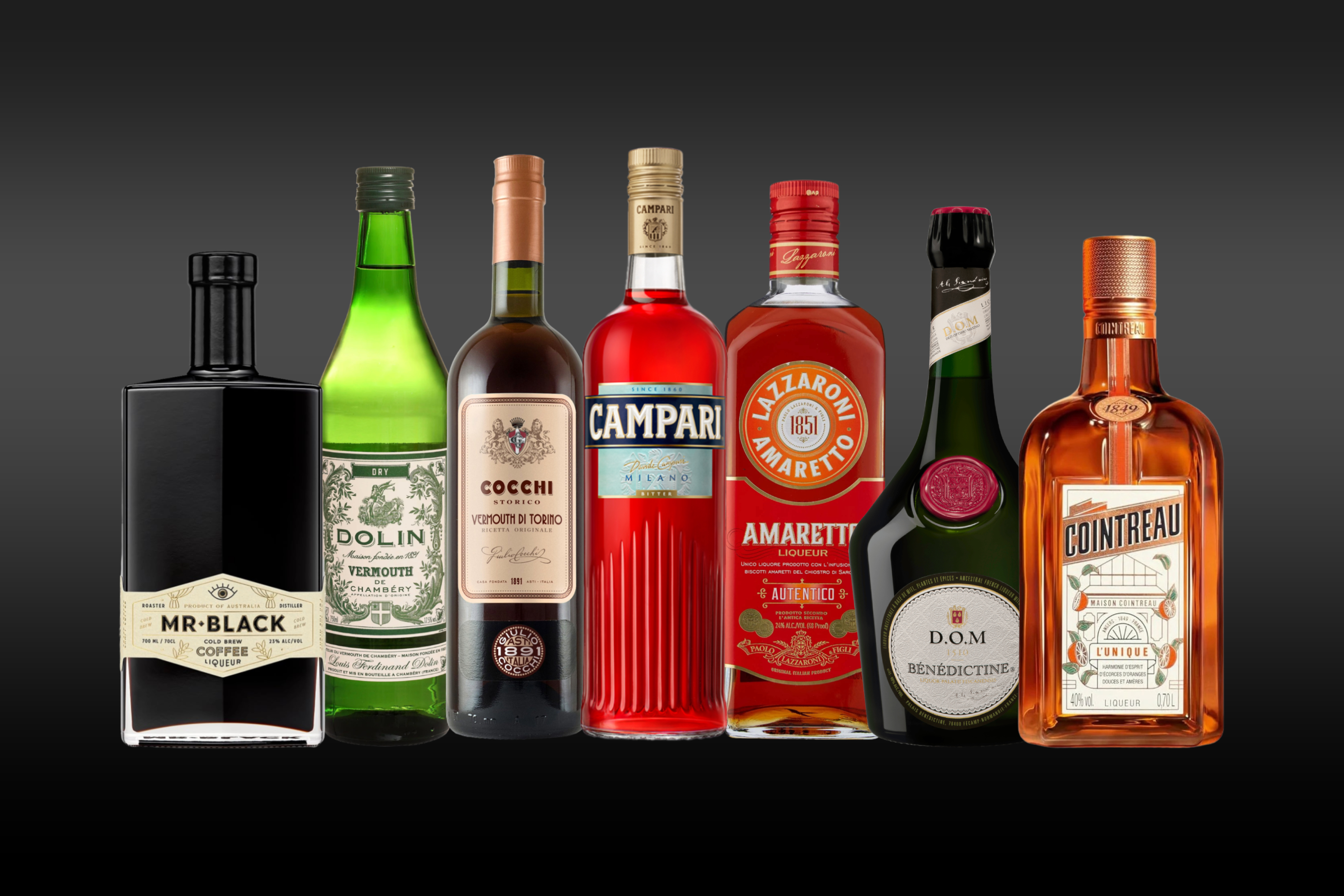
In this chapter of our home bar essentials, we break down the liqueurs and wines we like to keep on hand.
Liqueurs pack a great deal of flavour. Whereas spirits are usually little more than what comes out of a distillation, these concoctions have sweeteners and a whole range of other flavourings added: fruits, nuts, herbs, spices, flowers, you name it. In cocktails, you’ll find these do a lot of the heavy lifting, often more so than the base spirits.
We keep things pretty tight, since we don’t have a lot of wiggle room at home, but we find these eight bottles generally get the most mileage.
Amaretto: Lazzaroni
Typically made with the pits of stone fruit or with almonds, amaretto is mostly sweet and a little bitter, with an unsurprisingly dominant almond and maraschino cherry flavour. Besides cocktails, it’s also great for perking up desserts, particularly of the baked sort.

Lazzaroni is our favourite, mostly because it doesn’t run overly sweet, and a little bit because it’s usually more wallet-friendly than other brands, at around S$40 a bottle.
Campari
This is the liqueur we find ourselves reaching for nearly every day, since it shows up in most of our favourite recipes.

Incredibly versatile and called for in everything from negronis to spritzes, Campari adds bitterness, herbaceousness and sweetness with a bit of astringency and a pop of citrus flavour. We’ve heard it being likened to sucking on a grapefruit rind; it’s not a totally unfair comparison.
DOM Benedictine

No kidding, we grew up thinking DOM Benedictine was a drink only for folks who’d just given birth. (Were there ads that ran back in the day promoting its health benefits, or was that just Yomeishu?) This liqueur differs from Campari in that it’s more rounded and herbal, with a less prominent citrus note.
Coffee liqueur: Mr Black
You might think coffee liqueur belongs only in an espresso martini or whatever-coloured Russian, but it can be a surprisingly welcome addition to any number of classics. Our favourite twist is a coffee negroni, though we find it’s welcome in any smoky, dark and/or caramelly drink.
The coffee liqueur we all grew up with – Kahlua – deserves a mention here; it’s readily available and easily the most affordable option here.

Still, if you want a serious upgrade for not that much more money, try Mr Black. It boasts a lot more coffee flavour, though the cold-brew preparation means it also has a boatload of caffeine.
Triple sec: Cointreau

Orange liqueur, better known as triple sec, is an absolute staple. Extremely versatile, it can be added to just about anything for an extra kick of citrus and sweetness.
Case in point: Try swapping out half the Campari in a negroni for half an ounce of Cointreau.
Dry vermouth: Dolin Vermouth de Chambery Dry
Herbal, sometimes bitter and almost always a little savoury, dry vermouth is a must-have for countless classic cocktails.

Dolin Vermouth de Chambery Dry is a little sweet as far as dry vermouths go, but we like the ever-so-slight spiciness and generous touch of salinity. It’s also enjoyable with just a little soda water, some ice and a dash of bitters.
And while we’re here, remember to keep your vermouth in the fridge – always. It might make sense for a high-volume bar to leave its vermouth on the counter, but unless you’re going through a bottle every few days, we’d definitely say keep it chilled. Besides, cold vermouth (and cold everything, for that matter) works best in a martini.
Sweet vermouth: Cocchi Storico Vermouth di Torino

Like its dry counterpart, you’ll find sweet vermouth in a tonne of recipes. Our pick, Cocchi Storico Vermouth di Torino, hits hard on the berry and chocolate notes; we like it especially in a Manhattan.
Sparkling wine
Whereas vermouths impart a good amount of complex flavour into cocktails, with sparkling wines, something neutral and fresh works best.
A young prosecco does the job, and typically costs a fair bit less than champagne. Besides, the finer notes of champagne tend to get lost when combined with other ingredients.
We don’t have a specific recommendation here, though it’s worth pointing out that bottom-shelf bottles are perfectly fine. In our experience, we’ve never been disappointed by a sub-S$25 bottle of prosecco when used in a cocktail.
Like any other wine, what bubbles you pick up really depends on your preferred flavour profile. If you like your mimosas sweet and fruity, then go with that. If you like something drier, then go with some sort of brut.
Leave a Reply